Today, data is the fuel for AI. Companies spend vast amounts of money to organize, label, prepare it for AI training, or even simply access it when it belongs to someone else.
Ukrainian company Reenbit started working with data sets long before the «AI boom.»

«We clearly understand that every year, the amount of data created by businesses only increases. If you combine and organize it correctly, there are tremendous opportunities for analysis, which leads to better decision-making and improved business efficiency,» explains Volodymyr Yarymovych, co-founder and Chief Data Officer of Reenbit.
Reenbit’s core areas include custom software development, SaaS platforms, process automation, design services, and artificial intelligence. Over the last five years, especially with the rapid spread of AI, the company has doubled down on its data focus.
But the work goes far beyond AI. Reenbit’s expertise covers retail, e-commerce, fintech, energy, and even fashion. Its client geography spans Europe, Scandinavia, and the Benelux region, the UK, the US, Canada, and South Africa. With over 70 completed projects and dozens more in progress, many new clients come through referrals or by expanding existing collaborations. And an increasing share of these orders is specifically for data-related work: Reenbit has been turning raw data into real business value for years.
«When we work with data, we’re interested in much more than reports or dashboards,» says Volodymyr. «We look for answers to simple questions: Where can a business eliminate unnecessary movement and get more results? How do we reduce costs, optimize supply chains, boost team productivity, or react faster to shifting demand? Our job is to make these answers obvious, practical, and easy to use in daily decisions.»
What makes this process challenging? Scroll.media’s editorial team asked Reenbit about the nuances of working with data and uncovered a lot of insider details.
After a short intro about the company, Volodymyr immediately highlights the key challenge in data projects: clients want to see ROI as soon as possible.
«During our work, we try to close the entire project vertical as quickly as possible for at least one agreed metric. In practice, this approach works well — clients get interim results faster and understand the process better,» he explains.
Data work is complex. A full project typically takes 6–12 months. For clients without a technical background, it’s not always clear what requires so much time and effort. Yet they know that data can reveal where money is wasted, which processes slow operations down, where margins leak, which customer segments lack attention, and where exactly new growth potential lies.
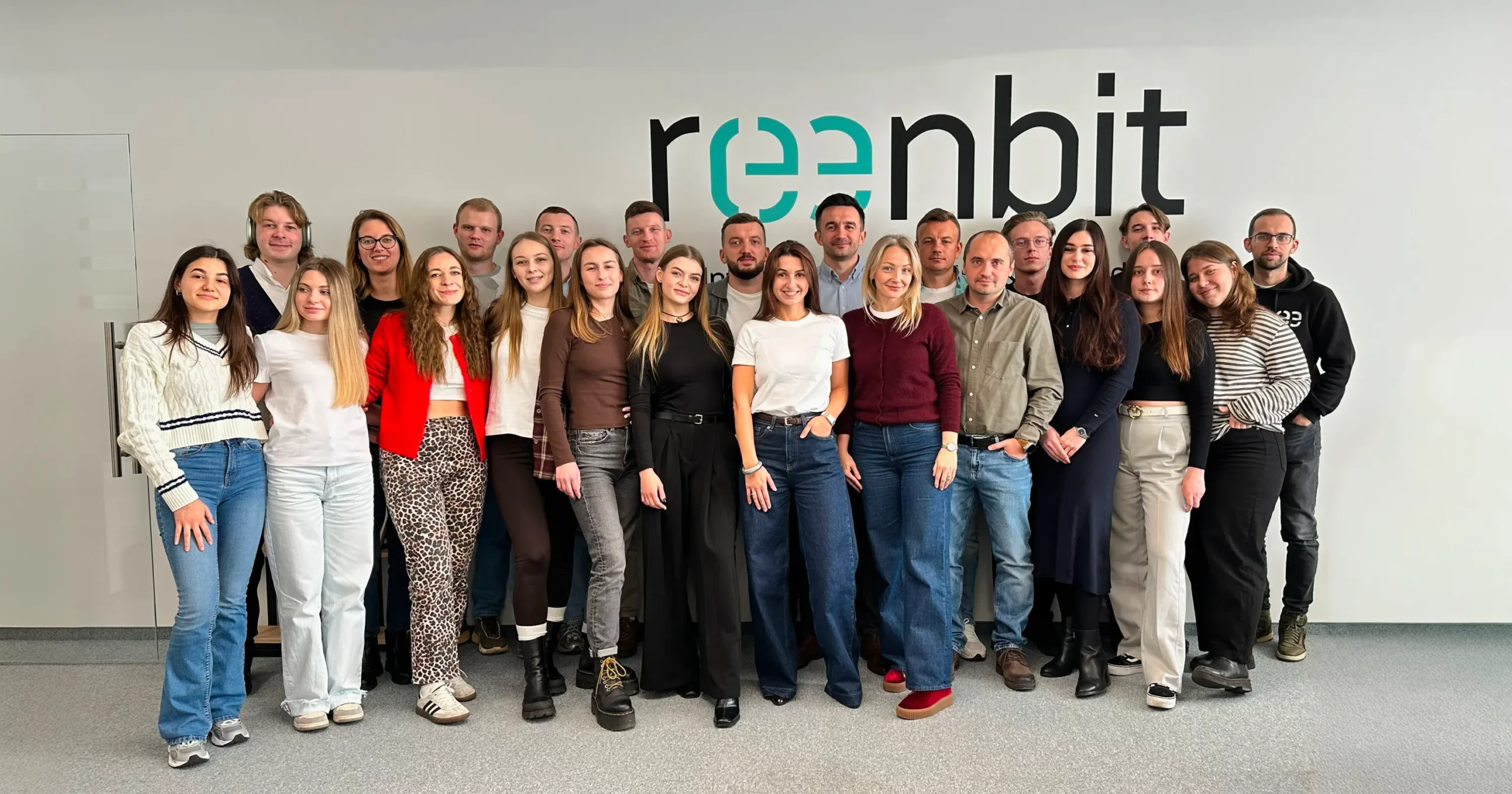

Photo by Reenbit.
Volodymyr arrived at this approach after working with a large Italian fashion brand. Although the entire plan had been approved, the client wanted immediate results. However, data collection — the first and most crucial stage — cannot be skipped.
«That’s when we discovered that a significant portion of the client’s data was corrupted due to a failed historical migration on their side. But it was difficult for them to understand why they still didn’t see dashboards,» Volodymyr recalls. The situation became an important lesson for our business.
The dashboard every Reenbit customer wants to see is essentially the final product. However, assembling it and defining what it should display is a substantial challenge in its own right.
Data as a driver of Reenbit’s business
To build a dashboard, you need high-quality data. That’s why Reenbit’s primary goal is to ensure quality and consistency. When analytics are built on insufficient data, businesses make decisions based on contradictions.
To avoid this, a significant effort is invested in cleaning the final analytical repository — filling gaps, removing duplicates, and resolving issues caused by legacy software. And Reenbit shows value even at this stage.
«People don’t always think about it, but building data analytics involves using specific tools, and some of them are extremely expensive. We train our engineers and analysts in business thinking so they understand client investments and the real ROI of the tools they choose. It’s easy to pick something trendy and expensive (like Fivetran), but those costs aren’t always justified for the customer. We try to choose the right toolset that helps clients save money,» Volodymyr explains.
Today, many believe data is needed mostly for AI, and that the market revolves around that. But as Reenbit notes, AI is only part of the current demand. Volodymyr shares an unexpected example: the fashion industry. And not in the context of boosting sales and quality analytics.
In recent years, major American and European fashion brands have been required to implement Digital Product Passports (DPPs) — regulators demand greater transparency for consumers, showing the full lifecycle of each item, including who made it, where, when, from what materials, and how. «This creates additional demand for data-driven projects in fashion. We now have several such clients,» shares Volodymyr, offering an inside look into an industry where, at first glance, data seemed to be used only for boosting sales.
Another interesting success story involves a consulting agency developing an analytical product for cost reduction. Companies uploaded their cost data and received dashboards showing where they overspent or underinvested.
«The foundation of the solution was comparative analysis using industry benchmarks from Gartner and Computer Economics. We considered industry, company size, and expense categories, calculated current spend, and visualized the comparison.
The challenge was technical as well: benchmarks arrived in PDF files with different structures. In the first MVP, we manually transferred numbers from graphs into our data model. Later, we automated the process — something AI now handles easily. Another challenge involved analyzing companies operating across multiple industries: we developed our own algorithm that merged benchmarks from different sectors and calculated a custom benchmark,» Volodymyr notes.
Regardless of whether the project is a DPP, AI product, or something entirely different, Reenbit follows the same core workflow:
- Stage one — discovery. The client describes the request, the metrics, update frequency, and what’s important to see. Reenbit also evaluates existing data and formats to determine whether it’s sufficient. The phase ends with selecting the tech stack and estimating implementation.
- Stage two — implementation. Here, delivering quick results for at least one metric is crucial. The phase includes development, testing, demo sessions, and iteration based on feedback.
- Stage three — support. After release, the team closely monitors operations and resolves issues — the standard support phase.
Depending on project complexity, 4–10 people may be involved: data analysts, data engineers, testers, project managers, and AI engineers. In one case, some client data even had to be transferred manually — a task now easily handled by AI.

«We do for others exactly what we do for our own business. We also actively implement data-driven solutions internally. Every department has dashboards automatically updated with their own operational data. We use AI and other tools as well. So talking to clients and understanding their needs is easy for us,» Volodymyr says.
Today, Reenbit aims to scale far beyond Europe and strengthen its presence in the US market. «We plan to continue growing our expertise in AI, because it’s a necessary complement to traditional data services and is in high demand right now,» concludes Volodymyr.